Arabuko Sokoke National Park

Arabuko Sokoke Forest Reserve

“Kenya’s Coastal Forest”

Listed as a UNESCO World Heritage site, Arabuko Sokoke Forest Reserve the largest remaining expanse of coastal forest in East Africa, and hosts some of Africa’s most rare and unusual creatures, which makes it an ideal African safari escape from Kenya’s Indian Ocean Coast.  

The 416sq.km (41,600 ha) reserve is located in Kenya’s Coast, between Malindi and Kilifi. Arabuko Sokoke Forest also lies 110km north of Mombasa City.

The concentration of rare species accounts for its status as the second most important site for conservation of threatened bird species on the African mainland. In addition, the forest maintains an underground fresh water system and supports a mangrove ecosystem located between the forest block and the ocean.

Kenya Safari Packages

6 Days Safari Kenya

10 Days Kenya Private Safari

Discover Kenya’s wilderness on this complete journey…

Samburu Safari Tours

7 Days Safari In Kenya

Enjoy the best week long private 7 days Safari in Kenya…

Serengeti River Crossings

4 Days Masai Mara Private Safari

Discover the big five wildlife in style with our exclusive …

Kenya Big Five Safari

6 Days Kenya Private Trip

A Kenya safari classic, combining the best of the best…

Tsavo Safari Tour

5 Days Kenya Safari

Journey to Kenya’s largest protected areas, featuring game drives …

Luxury Kenya Safaris

9 Days Luxury Kenya Safari

Join us on this luxury safari, visiting some of the most epic wildlife locations…

Masai Mara Safaris

5 Days Private Kenya Safari

Discover Kenya’s iconic destinations in this epic adventure…

Private Safari Kenya

6 Days Kenya Safari Tour

An unchartered wilderness journey on a 4×4 in Kenya’s intimate…

Arabuko Sokoke Forest Landscape & Scenery

The reserve’s main habitat is coastal dry forest. Additionally, there are three major vegetation forest types in Arabuko-Sokoke Forest;

Mixed Forest — this is a dense forest type which extends to about 7,000 ha on wetter coastal sands in the east of Arabuko-Sokoke. It has a diverse tree flora including Afzelia quanzensis, Hymenaea verrucosa, Combretum schumannii and Manilkara sansibarensis and the cycad Encephalartos hildebrandtii.

Brachystegia Forest — this is a more open forest covering about 7,700 ha, dominated by Brachystegia spiciformis on drier and infertile white sands through the centre of the forest.

Cynometra Forest — this is a dense forest or thicket on the north-west side of Arabuko-Sokoke, covering about 23,500 ha on the red Magarini sands towards the western side of the forest. It is dominated by trees of Cynometra webberi and Manilkara sulcata, and the euphorbia species Euphorbia candelabrum, but with reducing numbers. Brachylaena huillensis also used to be abundant in this zone, but its numbers have been severely reduced by extraction.

Each of these forests is home to different animal species, with several forest-fringed ponds with water lilies along the trails, as well as some viewpoints over the canopy whereas the eastern part of the forest lies on a flat coastal plain at an altitude of about 45 m.

Masai Mara River Crossings

The Tourist Attractions In Arabuko Sokoke Forest

Let’s have a look at nearby attractions at Arabuko Sokoke; –

Kipepeo Butterfly Farm; Visit this butterfly centre on a Friday morning, and you might spot exotic pupae being packed for export to the UK and USA. The farm pays locals to collect live pupae from Arabuko Sokoke Forest Reserve and the money is then reinvested back into conservation of the forests.

Gede Ruins; It traces its origin in the twelfth century but was rebuilt with new town walls in the fifteenth and sixteenth centuries. This extensive collection of coral palaces, mosques and town houses – some of Kenya’s most important Swahili ruins – lies quietly in the jungle’s green grip. The place retains a spooky, spiritual feel, watched over by a huge baobab in which several viewing platforms have been built.

Masai Mara River Crossings

Top Things To Do In Arabuko Sokoke Forest

Discover some of the best things to do in Arabuko-Sokoke Forest. The setting and climate of Southern Kenya allows for quality wildlife viewing all-round the year; from birdwatching, game viewing, and guided nature walks. Let’s have a look at the notable activities at Arabuko-Sokoke Forest.

1. Cycling & Picnicking In Arabuko-Sokoke Forest

The forest’s shady spaces, many trails available all through the forest and relaxed ambiance are a prescription for an easy bike ride or picnic. You can as well enjoy a picnic here as you ride around to explore the hidden secret of this forest on a pedaled wheel with a great cool breathe.

Picnicking; – for those who love picnicking, the forest is more than a reward with great setting and picnic site. You can drive here with family and friends and enjoy a wonderful picnic session here as it is allowed at the park.

2. Guided Trail Walks In Arabuko-Sokoke Forest

Guided walks is a fantastic way to explore Arabuko-Sokoke Forest. An up-close encounter with wildlife, and the chance to learn about the reserve’s ecology from knowledgeable guides.

There are beautiful trails and boardwalks for the nature lovers. Explore the forest on foot, and get a great retreat and you off from the usual city noise, just interacting with nature here. The cool forest breath is worthwhile and the sounds of the birds reward you with the best feel here. A network of well-marked walking trails is available. Visitors can follow several trails of varying length on foot at their own pace.

The centre of the forest has a viewing point at Nyari Cliffs, which can be reached by vehicle.

3. Butterfly Watching In Arabuko-Sokoke Forest

Being a tropical forest, it harbors a number of butterflies as the cool forest breath favor’s the breeding of the butterflies. For the butterflies’ watchers, here is the ideal place in Kenya to visit. A number of flying handkerchief butterflies are spotted here.

Butterfly farming is the most successful income-generating activity around Arabuko-Sokoke Forest. Farmers produce pupae from flying cages located in forest-adjacent villages, and sell these to the Kipepeo Project in Gede for export.

4. Bird Watching In Arabuko-Sokoke Forest

The reserve is mainly a bird-watching destination, and several endemics and near-endemics can be found here. The forest is a magical place to spend a couple of hours – and a welcome refuge from the coastal heat – but don’t expect to see any of the big safaris animals.

5. Exploring Mida Creek

This is a picturesque inlet near the entrance that attracts greater flamingos, sandpipers and crab-plovers. Take the boardwalk and use the bird hide here to get closer to these migrant birds.

6. Camping In Arabuko-Sokoke Forest

You’ll find 3 excellent campsites in the reserve – at the official campsite, up on the tall tree platforms, or at the Nyari Cliff, taking in a spectacular sunrise.

Animals & Wildlife In Arabuko-Sokoke Forest

Aside from several birding specials, the forest is home to at least 52 mammal species. Several are of particularly high conservation concern. Three species, the Golden-rumped Elephant-Shrew, Ader’s Duiker and the Sokoke Bushy-Tailed Mongoose are globally threatened, almost near- endemic species. Ninety percent of the world’s population of the Golden-rumped Elephant Shrew is found in the forest; the forest is also the only place to see the Aders’s duiker and Sokoke bushy-tailed mongoose.

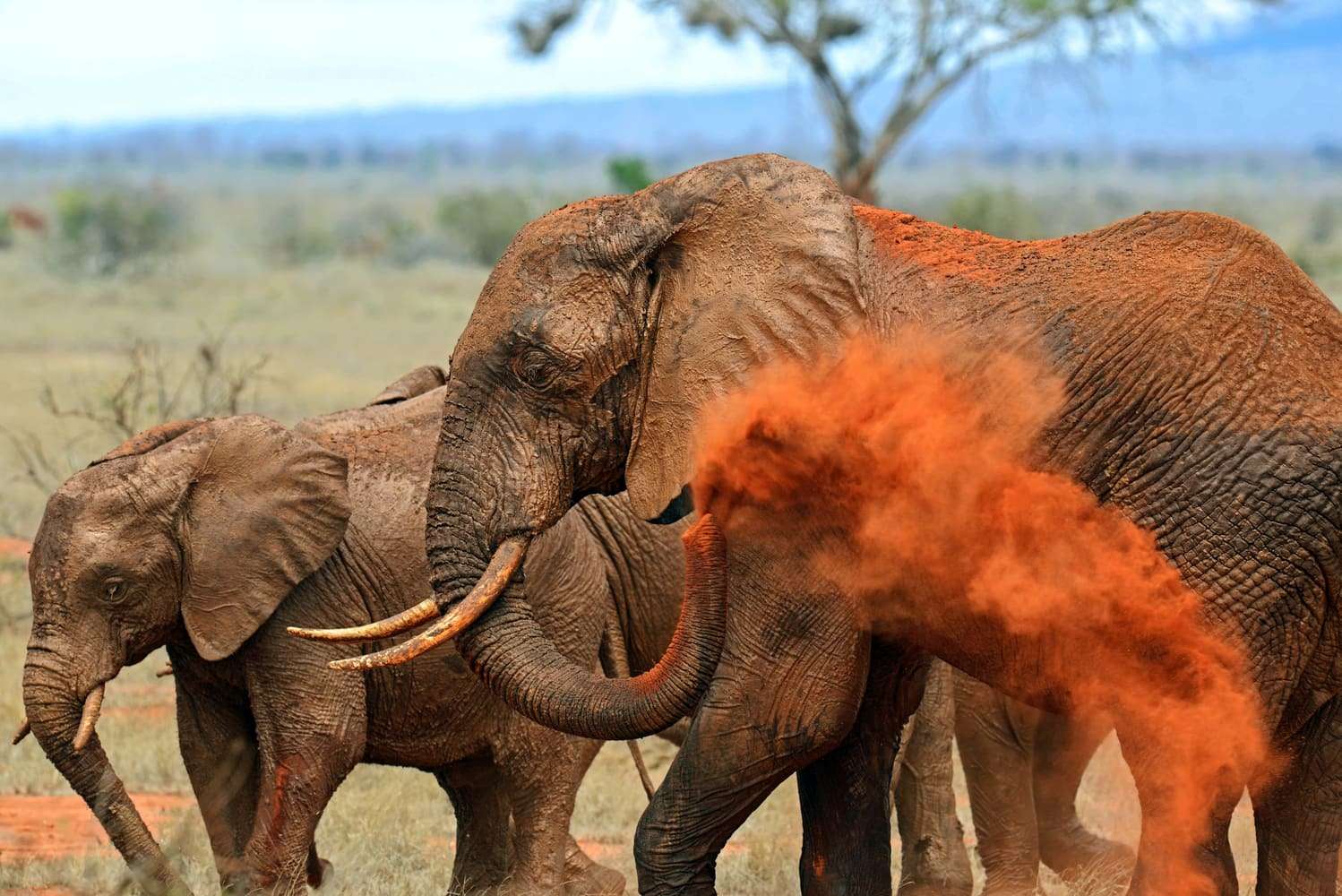
The six other antelope species are Red, Blue and Common Duikers; Common Waterbuck, Bushbuck, and Suni. Larger mammals are fewer, but there are between 80-100 African Elephant. Carnivores include African Civet; Blotched Genet and Caracal. The African Golden Cat, which is rare in Kenya, is thought to occur in the forest. Primate species include Sykes’ Monkeys, Yellow Baboons, Vervet Monkeys and Bush babies.

Birds In Arabuko-Sokoke Forest

Arabuko-Sokoke Forest has achieved a reputation as one of Africa’s most remarkable forests for birds. Anyone who has an interest in birds and who is on a beach holiday in Kenya will wish to visit it.  

Recording over 270 bird species, the forest features six globally threatened and three near-threatened species (including 5 restricted-range species), and 8 regionally threatened species. Arabuko-Sokoke Forest and several other much smaller forest fragments in coastal Kenya and Tanzania all together form the East African coastal forests Endemic Bird Area. Arabuko-Sokoke Forest has been ranked as the second most important forest for the conservation of threatened bird species on the mainland of Africa.

Popular Birds In Arabuko-Sokoke Forest

Crested guineafowl, Crowned hornbill, Lizard buzzard, Northern carmine bee-eater, and Silvery-cheeked hornbill.

List of Birds In Arabuko-Sokoke Forest

Southern Banded Snake Eagle, Fischer’s Turaco, Sokoke Scops Owl, Spotted Ground Thrush, Sokoke Pipit, East Coast Akalat, Amani Sunbird, Plain-backed Sunbird, Great Egret, White-backed Duck, Ayres’ Hawk Eagle, African Crowned Eagle, African Finfoot, African Pitta, Scaly Babbler, Little Yellow Flycatcher, and Clarke’s Weaver.

Best Time To Visit Arabuko-Sokoke Forest

It is possible to visit Arabuko Sokoke Forest Reserve at any time of year for both wildlife viewing and birdwatching. During the wetter months, but you’ll have lots more birds, especially the migrating ones as well as frogs. Or else, visit in the drier months, when the sunshine makes getting around that much more pleasant. Keep in mind, the months of April and May are much wet and therefore less ideal.

Masai Mara River Crossings

The Weather & Climate At Arabuko-Sokoke Forest

Rainfall is the most important climatic factor at Arabuko-Sokoke Forest, which, together with soil type, determines the type of vegetation in each zone. Rainfall is bimodal in pattern, beginning in April with the arrival of the monsoon which ends in June, with a second period of rainfall during November and December. January and February are the driest months. The annual average rainfall varies from less than 600 mm in the north-west part of the forest to over 1000 mm at Gede in the east.

Temperatures remain high for most of the year with a daily mean of 25° C, varying little from month to month, although March is usually the hottest month. Humidity remains high all year because of the proximity of the Indian Ocean.

Safari Tours To Arabuko-Sokoke Forest

Want to visit Arabuko-Sokoke Forest? Being close to Mombasa City, you can easily start off with short Mombasa daytrip tours then proceed to Shimba Hills making it easy to visit in a short time frame, and combine it with other parks as well.

You have plenty of choices to pick from, Arabuko-Sokoke midrange safaris to Arabuko-Sokoke luxury safaris depending on your travel style.

Ready To Plan A Private African Safari?

Browse our selection of private private tour packages in Kenya above, or get in touch with one of our African safari experts to help tailor-make the best itinerary for you.