
Time and again referred to as the birthplace of safari, the wildlife in Kenya is the main attraction for tourists visiting East Africa, not least due to the fact that during a safari in Kenya you see an amazing diversity of animals and birds that few other countries in the world can match. Known as one of Africa’s top safari destinations, a wildlife safari in Kenya delivers an exciting bucket list safari and some of the best game viewing in Africa.
Let’s uncover some of the wildlife can you expect to see on a Kenya safari tour.


Kenya Safari Animals & Wildlife, What You Will See On Safari
Kenya offers excellent wildlife viewing, with the Big Five regularly seen on safari. Masai Mara Park is best known for hosting the great migration between July or August and October. It’s also one of the best places in Africa to see big cats. White rhinos are easily seen at Lake Nakuru and Nairobi National Parks, and elephants are common in many places, especially Amboseli National Park. Lakes Bogoria and Nakuru, and the lakes of Amboseli, attract flamingos.


9 Days Luxury Kenya Safari
Join us on this luxury safari, visiting some of the most epic wildlife locations…

5 Days Private Kenya Safari
Discover Kenya’s iconic destinations in this epic adventure…
6 Days Kenya Safari Tour
An unchartered wilderness journey on a 4×4 in Kenya’s intimate…
Big Five Safari Animals In Kenya
In this case, we’re talking about iconic wild animals in Kenya – the lion, leopard, African buffalo, elephant, and rhinoceros – which you can see on the best safaris in East Africa.
The term “Big Five” refers to five large African mammals that are famed for their size and challenge to hunt back in the days. While giraffes are obviously tall and hard to miss, they aren’t part of the prestigious club, and neither are hippos.
In the north of Kenya, most notably Lake Nakuru Park, Ol Pejeta Conservancy and the Samburu National Reserve, you can see all of the Big Five. The leopard always seems to remain elusive and so an element of luck is required to see one.
Lastly, Kenya’s most famous park, the Masai Mara, is also home to all Big Five, but due to its sheer size the animals are more spread out and the chances of seeing them all are more limited.


1. The Lion - “Unmatched Courage & Strength.”
Lions hold a special place as apex predators. This dominance glues their status as the king of the jungle, displaying a supreme attitude.
In the wild, their powerful physique and strategic hunting skills ensure they sit unchallenged at the top of the food chain. Lions stand their ground, preferring to face their supposed challenger than to run and hide, showing confidence, a symbol of strength not just in body, but also in spirit; part of why lions have been associated with leadership and power in the animal kingdom.
Where to find Lions in Kenya
The Masai Mara National Reserve is without doubt the best place to see lions, boasting one of the highest lion densities in Africa. During the Great Migration (July to October), lions can often be seen hunting wildebeests and zebras in dramatic chases across the Mara plains.
Other best locations to spot lions include Tsavo East and West National Parks, Amboseli, and Laikipia Conservancy, where you can observe prides resting under acacia trees or patrolling their territories at sunrise.
2. The Leopard - “Ghosts Of the Forest.”
Known for their stealth, strength, and adaptability, leopards kill more than we think. Leopards are masters of stealth, often referred to as the “ghosts of the forest.” Their ability to move silently allows them to stalk prey undetected, making them formidable hunters. As nocturnal animals, they are primarily active at night, using their keen senses of sight and hearing to track down prey with unmatched precision. The leopard’s hunting technique is to either ambush its prey or to stalk it, a combination of stealth and sensory awareness is what makes leopards such successful predators in the wild.
Where to see Leopards in Kenya
Given its elusive nature, it’s often found lurking in trees or moving stealthily through thick bushes. Samburu National Reserve, Laikipia, and the Masai Mara offer some of the best places to see leopards in Kenya.
Laikipia Conservancies, The Aberdare Ranges and Mount Kenya National Park are also known for their rare black leopards, locally known as the black panthers of Kenya — an unforgettable sighting for lucky visitors.
3. The Cape Buffalo - “The Aggressive Bunch.”
The Cape Buffalo’s most characteristic feature is their horns. Both males and females have heavy, ridged horns that can grow to impressive sizes. The horns are formidable weapons against predators and jostling for dominance within the herd, they play a dangerous game. The African buffaloes are the most dangerous animals due to their physical size, aggressive nature, and formidable horns.
Where to Find Buffalos in Kenya
Expect large herds at Masai Mara, Tsavo, and Aberdare National Parks, as well as Meru National Park.
You’re almost guaranteed to encounter buffalos during your visit to all Kenyan safari destinations, as they are the most common among the Big Five animals.
4. The African Elephant - “It Never Forgets.”
Given that Elephants can swim – they use their trunk to breathe like a snorkel in deep water; they are also quite smart, and when faced with something or someone that does not intend them harm, they are gentle and peaceful. A herd of elephants is led by their mother, an older female (the matriarch) … When a group of elephants is travelling, the matriarch always takes the lead and directs the rest of the herd.
Where to See Elephants in Kenya
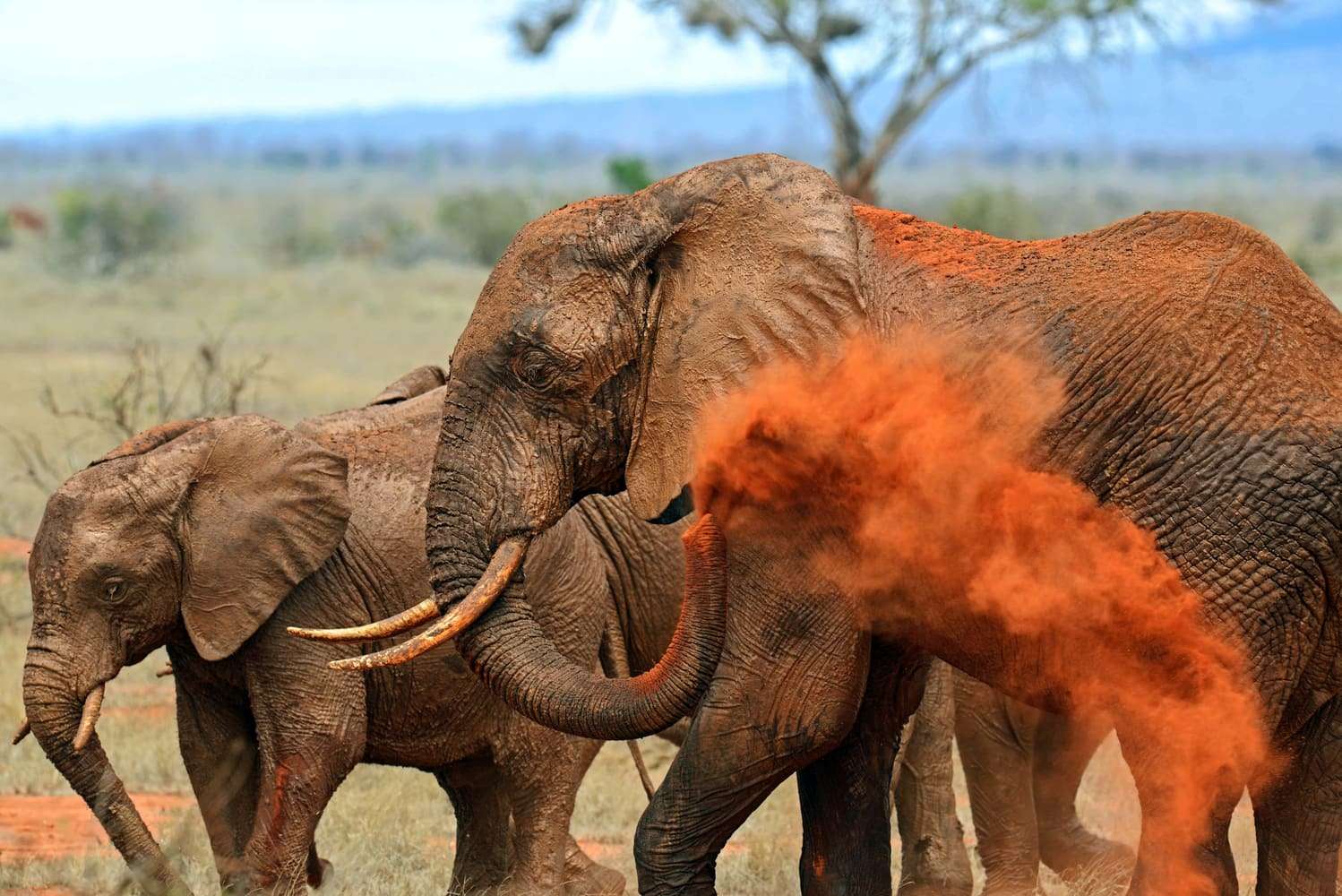
Amboseli is best place to see elephants in Kenya, with large herds foraging the park against the breathtaking backdrop of Mount Kilimanjaro.
Tsavo National Park also hosts Kenya’s largest elephant population, known for their reddish color due to the park’s volcanic soil. You can also find elephants in Samburu, Meru, and Aberdare National Parks.
5. The Rhino - “The Special One.”
The rarest of The Big Five is the rhino. Divided into two, the black and white rhino’s; rhinos are large (the second-largest land animal in the world, next to elephants) but quick, nearly as fast as the leopard when charging, and because of their elusive nature, they are quite a treat to photograph in your Canon while on one of our African photo safaris.
Where to see Rhinos in Kenya
Kenya is one of Africa’s leaders in rhino conservation, offering sanctuaries that protect both black and white rhinos.
Ol Pejeta Conservancy is home to the last two northern white rhinos in the world, making it a must-visit for wildlife enthusiasts.
Other key locations in Kenya that have rhino habitats include Lake Nakuru Park, Lewa Wildlife Conservancy, and Tsavo West National Park, where you can see these majestic animals roaming under strict protection.
What Animals Will You See on a Kenya Safari?
Apart from the Big Five safari animals, there is also the Big Nine animals. Well, we add another four animals to the Big Five list above, generally considered highly sought after for sighting during game viewing safaris in Kenya. These 4 additional animals are the Cheetah, Giraffe, Hippopotamus and the fairly abundant Zebra. Our clients often also ask us where in Kenya they’d be able to see all of the Big Nine animals. The secret is to combine at least 2 to 3 different safari parks in Kenya during your tour but Masai Mara National Reserve is one of the few places where all of the Big Nine wildlife may be spotted.
1. Cheetah’s
Cheetah are universally known for their speed, being the fastest land animals, touching upto 110 km per hour on short bursts during hunts.
Where Can You See Cheetahs in Kenya?
The Masai Mara’s relatively flat and treeless landscape is the perfect hunting ground for these Kenya animals, plus there are enough termite mounds to use as lookout points – cheetahs climb to the top where they can keep an eye on the Masai Mara wildlife and spot their next meal.
Other Kenya destinations where you will see cheetahs include; Amboseli, and Tsavo National Parks.
2. Giraffes
Kenya is home to three subspecies of Giraffes out of the 9 kinds that exists in the world. The reticulated or somali giraffe commonly found in Northern Kenya; Masai Giraffe which is the largest subspecies of giraffe, mainly found in Amboseli, Masai Mara and in Serengeti Tanzania; and the Rothschild giraffe which is one of the most endangered distinct populations of giraffe.
Where Can You See Giraffes in Kenya?
The predominant subspecies of giraffe that you’ll see on a Kenya wildlife safari are:
Rothschild’s giraffe (one of the most endangered) – visit Kenya Giraffe Centre or stay at Giraffe Manor in Nairobi for close-up breakfast with giraffes. Lake Nakuru National Park is also an important stronghold.
Reticulated giraffe – head to Samburu National Reserve or Meru National Park for the best sightings.
Masai giraffe – abundant in Kenya’s major parks like the Masai Mara and Amboseli.
3. Hippo (Hippopotamus)
The Hippopotamus are the third largest land mammal and the heaviest. They are easily recognized by their barrel-shaped torsos, wide-opening mouths revealing large canine tusks, nearly hairless bodies and columnar legs.
Where Can You See Hippo in Kenya?
Although you’ll spot this animal in abundance around the country’s permanent water sources, the best places to see hippos on a wildlife safari in Kenya are:
Amboseli National Park’s swamps and lakes
Tsavo National Parks
Masai Mara National Reserve
Meru National Park’s
Lake Nakuru National Park
Lake Naivasha
4. Zebra
Zebra are equids, members of the horse family, united by their distinctive black-and-white striped coats.They have excellent hearing and eyesight and can run at speeds of up to 56 kilometers per hour.
Where Can You See Zebra in Kenya?
The two subspecies found among wildlife in Kenya are the common plains zebra (found in almost all wildlife parks in Kenya) and Grevy’s zebra. The beautiful Grevy’s zebra, also known as the imperial zebra, is the largest living wild equid and the most threatened species of zebra. The Samburu National Reserve and the Laikipia region are the best places to see Grevy’s zebra on a wildlife safari in Kenya.
Mammals You See during Kenya Safaris?
Masai Mara is also home to a large number of other animals apart from the Big Five or Big Nine. This is a list of some of the other diverse wildlife you will find in Masai Mara Game Reserve, starting with a list of Mammals below.
Aardvark
The Aardvark is a small sized nocturnal mammal with a long snout and powerful claws, native to Africa. They have a hairless body with a pronounced arched back and short legs. The thick claws on the forefeet are well adapted for burrowing and digging. They are solitary animals and only come together to mate. They feed on insects, mainly ants and termites.
Aardwolf
Aardwolf is yellowish in colour with vertical black stripes and a bushy black-tipped tail and resembles a small striped hyena. Like the hyena, it has a long coarse ridge of erectile hairs along the length of the back, sturdy shoulders, and longer front than hind legs. Aardwolf is an insectivorous carnivore, native to East and Southern Africa. They are solitary and they rest in burrows during the day before becoming active at night. Their territory is between 1 and 4 square kilometres, depending on food availability, and they mark it with urine, dung and secretions from their anal glands.
African Hare
African hares are 20 inches long, weighs between 1.5 to 3 kilograms (3.3 to 6.6 lb) and feeds on leaves, buds, roots, berries, fungi, bark and twigs. They are commonly found in grasslands and wooded savannas throughout in Africa. They live mainly solitary lives, though they sometimes form groups of two or three when eating and use their senses of hearing, smell, and sight to avoid predators. The life span of the African hare is 12 years.
Antelopes
Antelopes are the unsung beauties of the bush and the grassland. They are commonly found on arid regions with bush or scrub cover and come in a variety of sizes and show true diversity and imagination with their head gear. There are 3 sub species, namely the Kirk’s Dik-Dik, klipspringer, and Oribi Antelope. It is one of the wild animals that most people would always associate with East Africa, present in Masai Mara and Kenya generally in large numbers.
Banded Mongoose
Banded Mongoose is brown or grey in colour and is easily identifiable by the dark bands across the back which stretch from shoulder to the tail. The animal is about 40 cm in length and weighs btween 1.3 to 2.3 kg. Banded Mongoose is commonly found in the central and eastern parts of Africa. These mongooses lives in savannas, open forests and grasslands and feeds primarily on beetles and millipedes. They use various types of dens for shelter including termite mounds and live in colonies with a complex social structure. They are commonly seen in groups in Tsavo, Amboseli and Masai Mara reserves.
Bat Eared Fox
Bat eared fox is a small african fox with enormous ears. Commonly found on short-grass prairies and arid grasslands, where they are most often seen foraging at night or in the early morning in warmer months and during the day when the weather turns colder. Its body is generally yellowish gray with black face and legs and black-tipped ears and tail; the throat and underparts are pale. They are highly social so if you spot one, keep your eye out for more. Majority of the bat-eared fox’s diet consists of small invertebrates such as ants, termites, spiders, scorpions and crickets. They will also eat small birds, mammals and reptiles, and even desert truffle.
Bushbaby
Bushbaby is a small arboreal and nocturnal primates with large round eyes that are good for night vision and exceptionally fine hearing ability. They have strong back legs that enable them to jump more than 5-6 feet in a vertical direction. They are agile, speedy climbers and their long tails give them added balance. They are gentle furry creatures that feed in seeds, nuts, fruits, flowers and insects. It is found in all major reserves/parks in Kenya particularly Masai Mara National Reserve.
Bushbuck
Bushbuck is a nocturnal, shy and usually solitary african antelope of the family Bovidae. They have a light brown coat, with up to seven white stripes and white splotches on the sides. The muzzle is also white and horns are found only on the males and they can reach over half a meter with only one twist. They mainly browse, but supplement their diet with any other plant matter that they can reach. Bushbucks are active around 24 hours a day, but tend to be nocturnal near human habitations.
Chimpanzee in Ol Pejeta Conservancy, Kenya
The chimpanzee also known as the common chimpanzee, robust chimpanzee, or simply “chimp”, is a species of great ape native to the forests and savannahs of tropical Africa. There are four confirmed subspecies and a fifth proposed subspecies of chimpanzees. They have thickset bodies with short legs, opposable thumbs, no tails, and long arms that are 1.5 times their height that extends beyond their knees. Much of their body is covered in coarse black hair, but the face, ears, fingers, and toes are bare. Chimpanzees are highly social, intelligent, curious and noisy. They live in groups that range in size from 15 to 150 members, although individuals travel and forage in much smaller groups during the day. They exhibit complex patterns of behavior, many of which are learned, and can solve problems, plan for anticipated events, as well as make and use tools. They have even been seen utilizing medicinal plants for a variety of ailments. The chimpanzees are listed on the IUCN Red List as an endangered species; habitat loss, poaching, and disease being their biggest threats. They exits in large numbers in Ol Pejeta Chimpanzee Santuary, Kenya.
Coke's Hartebeest
Coke’s Hartebeest is a medium-sized, fawn-colored antelope. It is one of the fastest antelopes and most enduring runners and is easy to recognise as it has long, narrow face and distinctively angular short horns (on both sexes) which are heavily ridged. The hartebeest feeds almost entirely on grass, but is not very selective and quite tolerant of poor-quality food. They are mainly found in medium and tall grasslands, including savannas. They can be easily spotted in Nairobi and Tsavo East National Park, Tsavo West and Amboseli National Park, and Masai Mara National Reserve.
Common Eland (oryx )
Common Eland is the second largest antelope in the world, being slightly smaller on average than the giant eland. Common eland are spiral-horned antelopes with both sexes having horns. They prefers savannah scrub to wide open spaces, but also avoids thick forest. It feeds on grass and tree foliage in the early morning and late afternoon, and is also active on moonlit nights. They are easily seen in Nairobi, Tsavo East and Tsavo West National Park and Masai Mara National Reserve. The common eland is the slowest antelope, with a peak speed of 40 kilometres per hour.
Copper Tailed Monkey/ Red Tailed Monkey
Copper tailed monkeys or Red Tailed Monkeys are found in East and Central Africa. They are more active in the early morning and evening. They communicate physically, vocally, visually and also demonstrate social dominance, submissiveness, or greeting. They are social primates that form groups of 7-30 individuals. The groups consist of one dominant male and females and their offspring. Groups generally stay together throughout the day and through life, except for males who reach maturity. They are omnivorous and feed on fruits but also eat leaves, flowers, or insects in times where fruit is scarce.
Crested Porcupine
The African Crested Porcupine is a very large, black-bodied, nocturnal rodent with long, black and white spines and a prominent crest of elongated, spiny hairs from forehead to shoulders. The adult crested porcupine has an average head and body length around 60 to 83 cm long, and weighs from 13 to 27 kg. It can be distinguished from others by its black rump and short, rattle-like quills in the tail. Crested porcupine are mostly seen in non-desert habitat in savannas, woodlands, steppes and uplands. They eat mostly plant material: fruits, roots, tubers, bulbs, and bark.
Dwarf Mongoose
Dwarf mongoose is a small African Carnivore belonging to the mongoose family. It is one of the two social species of mongoose, living in family groups of between 2 and 21 individuals with more female than male and fluctuating numbers of young ones. They are territorial, and each group uses an area of approximately 30-60 hectares (depending on the type of habitat). They are commonly found on Savannas, thicket and woodlands, typically with numerous termitaries for shelter. Although they survive seasonally waterless periods, they avoid very arid, open country. They feed on insects, notably crickets and grasshoppers, termites, scorpions and spiders. The gestation period lasts for 53 days and 1-6 young ones are born.
Grant's Gazelle
Grant’s gazelles are sandy brown on the back, clearly demarcated from a lighter colour on the flanks and white belly, and white around the tail and hind legs. Horns are found on both sexes. They are mostly identified by their colouring and long horns. These gazelles are often found in mixed groups alongside other herbivores. e.g. Wildebeest, Zebras and Thomson’s Gazelle. They may occur in large numbers (up to 500 individuals) in suitable areas. They exists in large numbers in Nairobi National park, Amboseli, Masai Mara, Tsavo and Marsabit National Reserve.
Grevy's Zebra
The Grévy’s zebra also known as the imperial zebra, is the largest living wild equid and the largest and most threatened of the three species of zebra, the other two being the plains zebra and the mountain zebra. It is distinguished by its unique stripes, which are as distinctive as human fingerprints. Foals are brown with reddish-brown stripes, and gradually their coats darken to black. The grevy’s Zebra are taller, have larger ears, and have narrower stripes than plains zebras. They are found in large number in Kenya and Ethiopia.
Honey Badgers in Kenya
Honey badger get its name from honey it so enjoy to eat. They also eat insects, amphibians, reptiles, birds, and mammals, as well as roots, bulbs, berries, and fruits. Honey badgers hunt by locating their victims with their acute sense of smell. They will then dig with their razor-sharp claws to extract their prey. Most honey badgers are active throughout the day, though near human settlements they may prefer the cover of darkness. They are often seen alone, though it’s not uncommon to spot mating pairs. They are notorious for their pugnacious and fearless personality, and have been known to take on animals many times their own size.
Impala in Kenya
Impala is a medium-sized antelope, reddish-brown in colour with white hair inside the ears, over each eye and on the chin, upper throat, underparts and buttocks. A narrow black line runs along the middle of the lower back to the tail, and a vertical black stripe appears on the back of each thigh. Impalas are found at grassland and woodland edges, usually very close by water, in eastern and southern africa. They are both graze and browse and eats young grass shoots in the wet season and herbs and shrubs at other times. Best places to find impalas in Kenya includes; Masai Mara National Reserve, Kisumu Impala santuary, Hell’s Gate, Nairobi and Lake Nakuru National Parks.
Kirk's Dik Dik
Kirk’s dik dik is the most common of the two dik-diks found in Kenya. The dik-dik is a tiny antelope, reddish-brown colour on the back, with lighter flanks and white belly. They are easily recognised by almost lack of a tail and the tuft of dark hair on the forehead. Horns (found only on males) are so short that they are often lost in the hair tuft. Dik-diks are highly nocturnal, and during the daytime seek shade to rest throughout the hottest parts of the day to help avoid the loss of valuable fluids. They can be spotted easily in Nairobi, Tsavo East and West and Amboseli National Park as well as Masai Mara National Reserve.
Klipspringers in Kenya
Klipspringer is a small, sturdy antelope; standing about 50cm at the shoulder. They are easily recognised by their curious ‘tip-toe’ stance and the greenish tinge of their speckled coarse hair. Their horns are short and widely spaced. Klipspringer are most often seen on rocky outcrops, or in the grassland in the immediate vicinity, and when alarmed they retreat into the rocks for safety.Best places to find klipspringers in Kenya includes; Masai Mara National Reserve, Amboseli and Meru National Park as well as Tsavo East and Tsavo West National Park.
Olive Baboons
Olive Baboon is one of the largest baboons, with a black face and a greenish-grey coat that covers its bodies. The olive baboons inhabit savannahs, steppes and forests and are very adaptable.They live in troops of males and females that consist of between 20 and 50 members, but sometimes these troops can consist of over 100 baboons. They feed on grass, seeds, leaves, cereals, fruit, tubers, small mammals, invertebrates and young birds.
Oribi
Oribi is a small, swift african antelope with long, slender neck and legs. The coat is rufuous brown with white underparts. The ears are oval and the tail is black. The oribi is the only dwarf antelope and perhaps the smallest ruminant. They are commonly found in grasslands maintained by fire or heavy grazing. Oribi prefers flats or gentle slopes and is commonest on open lawns of grass kept short by compaction, poor soils. They are relatively uncommon, and chances of spotting one is in Masai Mara National Reserve.
Pangolins In Kenya
Pangolins are the only mammals covered in protective keratin scales. When threatened, they roll up into a ball to protect themselves. They live in hollow trees or burrows, depending on the species. Pangolins are nocturnal, and their diet consists of mainly ants and termites, which they capture using their long tongues. They tend to be solitary animals, meeting only to mate and produce a litter of one to three offspring, which are raised for about two years. Although they are one of Africa’s most elusive creatures and rarely seen, pangolins can be spotted in Masai Mara National Reserve.
Reticulated Giraffe in Samburu National Reserve
The Reticulated Giraffe also known as the Somali giraffe, is a subspecies of giraffe native to the Horn of Africa. They are widely found in Somalia, southern Ethiopia, and northern Kenya. It is estimated that there are 8,500 to 9,000 Reticulated Giraffes living in the wild. Reticulated Giraffe coat consists of large, polygonal, liver-colored spots outlined by a network of bright-white lines. The blocks may sometimes appear deep red and may also cover the legs. Male Reticulated Giraffes reach a towering 18 feet tall and weigh between 2400 and 4250 pounds, while the female Reticulated Giraffes measure up to 17 feet tall and weigh between 1540 and 2600 pounds. They are also fast and are able to gallop up to 56 kilometres per hour.
Side Striped Jackal in Kenya
Side striped jackal is a medium-sized canid, with shorter legs and ears compared to other Jackals. It can be easily recognised by the white tip to its tail and by the poorly defined black and white stripes along the flanks. They mostly feed on invertebrates and small vertebrates eg; fish and gazelle fawns as well as fallen fruits, unripe maize, carrion and organic rubbish. They are most common in moister habitats.
Slender Mongoose in Kenya
Slender mongoose is a long-bodied, short-legged, partly arboreal mongoose, extremely variable in colour. The digits of the hands and feet splay readily and are armed with small but sharp color. The tip of the tail is usually black tipped. Males weigh 640-715 g, while the smaller female weigh 460–575 g. Slender mongoose are the most common species of mongoose of sub-Saharan Africa. They are found in all wooden, .Savannah, thicket and forest habitats and forest swamps. It Slender mongoose feeds on rodents, insects, reptiles, frogs and birds.
Spotted Hyenas in Kenya
Spotted Hyena also known as laughing hyena, is the largest member of the hyena family, and is easily distinguished physically from other species by its rounded ears, its vaguely bear-like build, its less prominent mane, its spotted pelt, its more dual purposed dentition, its fewer nipples and the presence of a pseudo-penis in the female. In contrast to most other female mammals, the female hyena are male-like in appearance, larger than males, and substantially more aggressive this is beacuse of their social structure and an increase in testosterone in its fetal stages. Female hyenas are highly social and dominate the male hyenas, with the largest group sizes and most complex social behaviors.
Spring Hare in Kenya
The African Spring Hare is a nocturnal, long-tailed, hopping rodent with long, soft fur, varying from warm reddish tints to yellow-grey above and white to pale tawny underneath. It has short forelegs but long, powerful hind legs and feet used for jumping. Found locally in the semiarid steppes and dry savannas of Kenya. Spring hare feeds on fresh grasses, grazed to the ground stems, roots and storage bases of grasses, new sprouts of herbs and fruits. They sometimes eat insects, such as locusts. They feed only at night and within about 400m of burrow.
Straw Coloured Fruit Bats in Kenya
Straw coloured fruit bat is the second largest fruit bat in africa and it gets its name from the yellowish or straw-colored fur around the neck. Their bodies vary from the straw colour of their name to pale yellow or dark brown-grey. These bats are very strong fliers, with long, pointed wings built for endurance over agility. Because of this, they can’t manoeuvre in tight spaces and find their food in the more open upper canopy layer. They live in a wide range of habitats across sub-Saharan Africa. They prefers moist and dry tropical forests, because there is so much fruit, although they also eat blossoms and young shoots of silk-cotton trees but will use various other forest habitats and even urban areas. They are highly social species and travel in massive colonies of at least 100,000 bats.
Thomson's Gazelle
Thomson’s gazelles are medium-sized antelopes, with a head and body length of 80 to 120 cm, a tail length of 15 to 27 cm, and height at the shoulder of 55 to 82 cm. It is often confused with the much larger (38-80kgs) Grants Gazelle, however it is more easily identified by its thicker black tail, shorter horns and more obvious black stripe on the flank. Thomson’s gazelles prefer savannas and grassland habitats, particularly in the Serengeti region of Kenya and Tanzania.
Topi in Kenya
Topi is a medium-sized antelope, highly social and fast type of antelope found in the savannas, semi-deserts, and floodplains of sub-Saharan Africa. They have elongated heads, a distinct hump at the base of the neck, and reddish brown bodies with dark purple patchings on their upper legs. They also have a mask-like dark coloration on the face. Their horns are S-shaped and ringed. Males tend to be larger and darker than females. Primarily lives in flood plains, but they are sometimes found in dry areas of open savanna and park woodland, taking to the shade during the heat of the day. They prefer flat lowlands, and can go without water for long periods of time only if they have access to green pastures. In Kenya, they are mainly found in Masai Mara where they exists in large numbers. Their main predator is lion.
Vervet Monkeys in Kenya
Vervet Monkey is a small, black faced monkey with a white fringe of hair, while the overall hair color is mostly grizzled-grey. Adult male weighs averagely 5.5 kg, and have an average body length of 490 mm. Whereas an adult female weighs an average 4.1 kg, and have an average body length of 426 mm. Vervet society is built on complex but stable social groups (called troops) of 10 to 50 individuals—mainly adult females and their immature offspring. They eats a primarily herbivorous diet, living mostly on Leaves and young shoots- but bark, flowers, fruit, bulbs, roots and grass seeds are also consumed. The mainly vegetarian diet is supplemented with insects, grubs, eggs, baby birds and sometimes rodents and hares.
Warthogs in Kenya
Warthog is a medium sized species, easily identified by its two pairs of tusks protruding from the mouth and curving upwards. It is the most common wild pig in Kenya and the most frequently observed wild pig in Africa. Their most endearing habit is the way they turn tail and trot away with their thin tufted tails stuck straight up in the air like some antenna. Warthogs are distributed throughout the savannah and semi-arid areas of sub-saharan africa. They are often seen in family groups, with parents and piglets trotting briskly in a straight line with tails erect. Warthogs are herbivores and diurnal animals that spend much of their day foraging for food. Best places to see them in Kenya are in the Masai Mara National Reserve, Nairobi and Amboseli National Parks.
Waterbucks in Kenya
Waterbuck is a long bodied antelope with rather short sturdy legs, easily recognisable by its thick, shaggy, dark brown coat and white inner thighs. The horns are present in males only which they use to defend themselves if attacked, and these curve gradually outwards then grow straight up to a length of about 75cm.The female and young ones move in vicinity of a number of territorial males,or may stay with one male. They feed on grass,reeds,and some foliage. It is fairly common and easily seen in Nairobi and Lake Nakuru National Park and Masai Mara National Reserve.
Wildebeest in Kenya
Wildebeest are the largest species of the antelope family. There are two species, black wildebeests and blue wildebeests. Both species of wildebeest are even-toed, horned, greyish-brown ungulates resembling cattle. The front end of their body is heavily built, while the hindquarters are slender with spindly legs. They have a gray coat and a black mane as well as a beard that can be black or white. There are several races of wildebeest. The species forming the large herds of the Serengeti-Mara ecosystem of Kenya and Tanzania is known as the western white-bearded wildebeest. Their favourite habitats are open woodlands and open grassy plains.
Birds & Birding Safaris In Kenya
With more than 1,100 recorded species, Kenya is one of Africa’s best birding destinations. Numerous endemic and near-endemic species, which are especially sought-after as they only occur within the country or marginally beyond, can be seen on any birding trip. European and northern African migrants are present in Kenya from November to April.
Although not an obvious choice of destination for Birding in Kenya, which after all is home to some of the best birding hotspots in the world, Masai Mara is still a very good place for Ornithological tours, with over 500 species recorded, with many of these being raptor species.
Popular Birds In Kenya
Crowned hornbill
Hartlaub’s bustard
Scarlet-chested sunbird
Southern ground hornbill
White-bellied go-away-bird
Endemic & Near-Endemic Birds In Kenya
Abbott’s starling (near-endemic)
Aberdare cisticola (endemic)
Amani sunbird (near-endemic)
Clarke’s weaver (endemic)
Grey-crested helmet-shrike (near-endemic)
Hinde’s pied babbler (endemic)
Jackson’s spurfowl (near-endemic)
Jackson’s hornbill (near-endemic)
Montane white-eye (endemic)
Sharpe’s longclaw (near-endemic)
Sokoke pipit (near-endemic)
Sokoke scops owl (near-endemic)
Taita thrush (endemic)
Tana River cisticola (endemic)
Taveta golden weaver (near-endemic)
Williams’s lark (endemic)
Other Lists of Birds In Kenya
Abyssinian crimsonwing
Bar-tailed trogon
Blue-headed bee-eater
Friedmann’s lark
Golden-breasted starling
Golden-winged sunbird
Great blue turaco
Kori bustard
Red-naped bush-shrike
Secretary bird
Somali courser
Somali sparrow
Taita apalis
Turner’s eremomela
Vulturine guineafowl
Yellow-bellied wattle-eye
Best Time for Bird Watching In Kenya
The birdlife in Kenya is good year-round, but at its prime from November to April when the migratory birds from Europe and northern Africa are present. At this time, many resident bird species are nesting and are in breeding plumage. For wildlife viewing, however, the Dry season (June to October) is better. January and February can be good months for both.
Best Parks for Birding Safaris In Kenya
The best wildlife-viewing parks, such as Masai Mara National Reserve and Amboseli National Park, also happen to be outstanding birding destinations. The Rift Valley lakes, including Lakes Nakuru and Bogoria, are good for waterbirds (including flamingos, which you can also see in Amboseli). The arid north, including Samburu National Reserve, offers many dry-country specials, while Arabuko Sokoke Forest Reserve and Kakamega Forest are birding hot spots for forest species.
Best Time for Wildlife Viewing In Kenya
Kenya offers outstanding wildlife viewing throughout the year, but the ultimate time is the Dry season (June to October). This corresponds partly with the wildebeest migration in the Masai Mara. The exact timing varies, but the herds are usually present in Kenya from July or August to October, when the animals begin moving back into Tanzania. These months are also high season for tourism. November to April is generally best for birding with migratory species present.