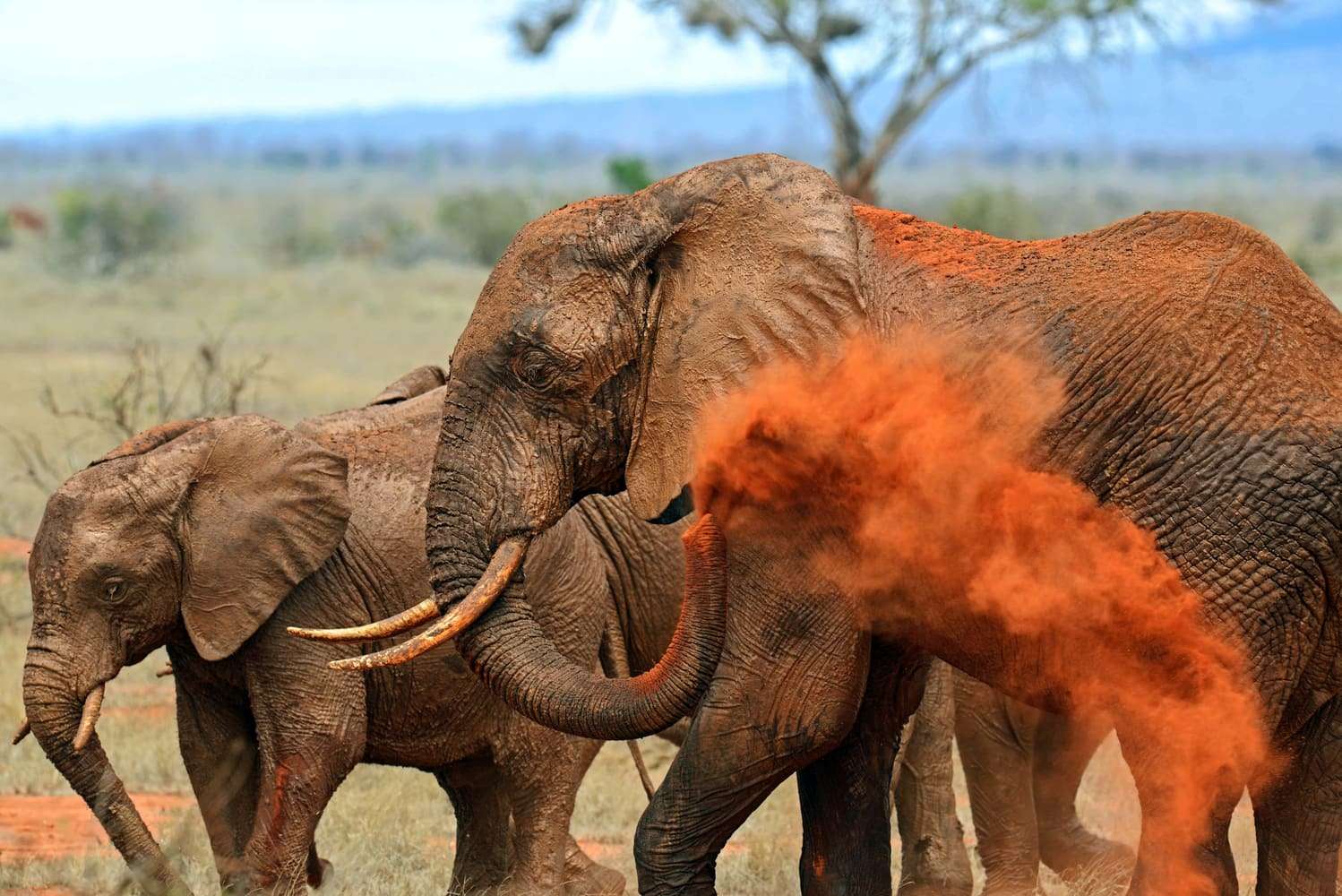
Tsavo West Safari Destination
Popularly known as the land of Man-Eating Lions, Tsavo West National Park is located in Taita-Taveta County of Kenya, covering a total area of 9,065 square kilometres. Together with Tsavo West National Park, they both form an area of about 22,000 square kilometers; – the biggest and oldest Kenya’s parks.
Dotted with dramatic lava flows and graced by the unique Mzima Springs, Tsavo West Park is a more popular destination due to its magnificent scenery, the rich and varied wildlife, a good road system, a rhino reserve, rock climbing potential and guided walks along the Tsavo River, that said, others find it a little frustrating when it comes to seeing animals.
Tsavo West is home to the African Big Five, but wildlife viewing can be a bit slow. Highlights include recent liquid lava flows and lush Mzima Springs with its close-up views of hippos. Painted on a sprawling canvas of endless skies, emerald hills, sights of palm fringed rivers, teeming wildlife and sparkling oasis set against the impressive backdrop of mile upon mile of cloud shadowed African savannah, Tsavo West National Park is a true wilderness.


Tsavo Safari Packages
4 Days Masai Mara Private Safari
Discover the big five wildlife in style with our exclusive …
9 Days Luxury Kenya Safari
Join us on this luxury safari, visiting some of the most epic wildlife locations…
5 Days Private Kenya Safari
Discover Kenya’s iconic destinations in this epic adventure…
6 Days Kenya Safari Tour
An unchartered wilderness journey on a 4×4 in Kenya’s intimate…
Tsavo West Landscape & Scenery
Tsavo West Park is more mountainous and wetter than its counterpart, with swamps, Lake Jipe and the Mzima Springs. Additionally, it has a rugged, arid beauty, with varied landscapes of thick woodlands, rocky outcrops, and volcanic hills and lava flows.
In addition, Tsavo West landscape features over 1,000 plant species and a mixed habitat of bush, grasslands and acacia woodlands dotted with baobab, ivory palm, saltbush, doum palm, tamarind and fig trees. The sight of Ngulia Hills run like a spine through the park. Once you step foot here, the park’s black volcanic soil and Tsavo’s famous red dust is something very notable. A small number of rivers meander through the park, but Mzima Springs stands out.
The Best Tourist Attractions In Tsavo West Park
Let’s have a look as to why Tsavo West is more scenic. On your safari to Tsavo West National Park, the game drives will take you in search of wildlife, pods of hippos, giant crocodiles and a series of bird species; – But there is more to it.
1. Mzima Springs
Mzima Springs; the remarkable Mzima Springs is an impressive sight of a million gallons of crystal-clear waters gushing out of the under parched lava rocks, filtered through the volcanic rocks of the towering Chyulu Hills just to the north; – the view here makes up the most welcoming and lovely scenes from Africa’s rolling jungle. Additionally, the lakes swarm with fish, large crocodiles and some big pods of hippos. If you’re lucky, the underwater viewing chamber, accessed by a pier, can provide unique photographic opportunities – of a sinuous, gliding crocodile, or the delicate, tiptoe, swimming-walking style of a hippo.


2. The Shetani Lava Flow
The Shetani Lava Flow; the molten lava that forms Shetani lava spilled from the earth about 200 years ago and according to the local folklore, the fiery fury was work of the devil. A wide expanse of lava flows in the park, with several places where you can get out of your vehicle and stretch your legs, including a series of lava caves below the surface. This black lava spreads for approximately 50 sq km across the savannah near the Chyulu Hills, looking strangely in the form of a blanket.


3. Shetani Caves
Shetani Caves; Cave exploration at Shetani lava flow is also another activity visitors can enjoy – the caves were used to trap prey animals that had stumbled inside in search of water, and then trapping predators that had followed them. Close to the Shetani Lava Flows, Shetani Caves are a result of volcanic activity. You’ll need a torch (flashlight) if you want to explore, but watch your footing on the razor-sharp rocks and keep an eye out for the local fauna.


4. Chaimu Crater & Roaring Rocks
Chaimu Crater & Roaring Rocks; At the far end of the vast, darkened expanse of the Shetani Lava Flow rises the isolated Chaimu Hill at hand with low-lying cojoined hillocks. Another highlight; – the picturesque identical five sisters of Tsavo hills are a volcanic feature that provides a scenic backdrop for wildlife photography.
These two natural features offer stunning views of the Chyulu Hills and birds of prey circling high above the plains. The Roaring Rocks can be climbed in about 15 minutes; However, while there’s little danger, the KWS rangers warn that in Chaimu Crater ‘be cautious when here since the crater and lava may shelter snakes and large sleeping mammals. When you get to the top, you have superb 360-degree views of Tsavo area.


5. Poacher’s Lookout
Poacher’s Lookout; this hilltop vantage point in Tsavo West Park offers fine panoramic views over the park, and especially fine views west to the plains of the Amboseli environment and Mt Kilimanjaro. Both the Poachers Lookout and roaring rocks is a great vantage point from which to catch a bird’s eye view of the scenic topography; – be sure to make use of your binoculars while here. You can even spot wildlife from this area.


6. Ngulia Rhino Sanctuary
Ngulia Rhino Sanctuary; Tsavo West is home to the Ngulia Rhino Sanctuary; a special sight where the growing population of highly endangered black Rhino. At the base of Ngulia Hills, this 90-sq-km area is highly protected and serves as a sanctuary for this special wildlife. Given their nature, black rhinos, apart from being understandably shy and more active at night, are browsers, not grazers, and prefer to pass their time in thick undergrowth.


7. Taita Hills WWI Museum
Taita Hills WWI Museum; Learn more about the second largest protected area in Kenya and stories about man eater lions who to date carry a strange history long after they terrorized, injured and killed construction workers of the Kenya-Uganda Railway in 1898. The railway construction was abruptly stopped by the most hungry and voracious man-eating lions.
Discover the lobby in the Taita Hills Game Lodge, this engaging little open-sided museum tells the story of WWI as it played out in East Africa. Explore artefacts found on the nearby former battlefields (from bullets made in 1912 to glass shards from bottles of Indian hair oil), archival photos, informative and detailed panels on the course of the war and major personalities.


8. The Tsavo River
The Tsavo River; Meandering eastward from the western fringes of Kenya’s Tsavo West National Park, near the Tanzanian border, the Tsavo River charts a course until it converges with the Athi River, giving rise to the Galana River in the heart of the park. Tsavo River serves as an important channel, providing for a diverse number of wildlife including Hippo’s, Nile Crocodiles, African Fish Eagle: precision predators over Tsavo’s waters, Elephants and Egrets among others.
In addition to the Tsavo River is Lake Jipe that lies astride Kenya and Tanzania boarder teems with aquatic life while bird watching is also a major activity for bird lovers around the lake.


9. Lumo Wildlife Sanctuary
Lumo Community Wildlife Sanctuary; Covering over 46,000 hectares, Lumo Community Wildlife Sanctuary (LUMO) is an environmental gem in southern Kenya, sandwiched between the Taita Hills Wildlife Sanctuary and Tsavo West National Park. This Wildlife Sanctuary, forms part of the larger Tsavo National Park, playing a key role as a wildlife corridor, thus fostering biodiversity and ensuring free movement for migratory animals, especially elephants. The Conservancy is characterised by a mosaic of open savannahs, rolling hills, riverine woodlands, and waterholes.


Top 4 Things To Do In Tsavo West Park
Discover some of the best things to do in Tsavo West. The setting and climate of Tsavo allows for quality wildlife viewing all-round the year; from birding, bush sundowners, and guided nature walks. Let’s have a look at the notable activities that Tsavo West offers.
1. Safari Game Drives In Tsavo West
Similar to Tsavo East, the main activity in Tsavo West National Park is the guided game drives, which will take you around the park in search of animals and bird species. The game viewing drives normally start as early as 6:00am. when the gates open, and involve the use of a 4X4 Land Cruiser Jeep with an open roof-top.
As for Night Game drives, a curiosity for many visitors while on an African safari. Please Note that night game drives are not allowed inside the main Tsavo West National Park.
The Land Cruiser safari vehicles accommodate 6 seat passengers (everyone with their own spacious window seat) but can additionally seat up to 8 adults with an extra seat included and with one person sitting beside the Driver. The vehicle has a spacious game viewing roof, is more reliable, strong and spacious enough while also being marginally more comfortable than the only other option.
2. Underground Viewing Waterhole In Tsavo West
One of the most unique aspects of Mzima Springs is the underwater viewing chamber, where visitors can go downhill into a submerged structure to watch fish swim gracefully through the water. The blue Barbel fish are especially visible, darting through the water in search of food. The experience provides a rare opportunity to view the aquatic life up close, making it a memorable part of the visit.
While hippos tend to stay clear of the chamber, you may occasionally spot them bobbing at the surface or submerging just beyond your view. The crocodiles tend to be more elusive but are often seen sunbathing near the water’s edge. Upon arrival at Mzima Springs, you’ll embark on a 1-kilometer walk that meander through lush, green vegetation.
3. Birding Safaris In Tsavo West
With only two activities permitted in Tsavo West National Park. Similar to Tsavo East, Tsavo West has an astounding number of bird species.
With over 600 bird species recorded in the area, birdwatching in Tsavo West is a popular excursion for many birding lovers, which will be done together with wildlife viewing, both of which you’ll most likely enjoy on a guided game drive.
4. Bush Meals, Dinners & Sundowners In Tsavo West
Delight in the wide-open sky and space of Tsavo West plains on an unforgettable bush sundowner at Tsavo, where you will be served drinks and cocktails while watching the sight of the African sunset. This usually happens as the sun begins its descent, the sundowner begins with a gentle evening game drive, arriving at the sundowner site just as the evening sky turns gold-pink, surrounded by nothing but scenic views framed by stunning landscapes and magnificent wildlife. (Can at times take place within the lodge premises).
Your chairs will be set up facing towards the extensive scenic Tsavo West plains, accompanied by a well packed mobile bar service and cocktail snacks served in the raw wilderness of the African savannah. Musical entertainment can also be provided at request. After sunset you will be driven back to the lodge in time for dinner.
Picnic Lunch: usually arranged during a full day game outing in the reserve so that one does not have to go back to the lodge or camp for lunch, the meal itself is in the form of packed lunch boxes which are provided by your camp or lodge by prior arrangement the night before to allow them adequate time to prepare the meal boxes. The meal will be enjoyed under a tree, on a scenic setting out in the wild.
Bush Breakfast & Dinners: in the case of a Bush dinner, this could also be an event in itself around a bonfire with entertainment such as light music or tribal dance performances. Bush meals are typically arranged at special chosen sites within Tsavo East National Park – generally located outside of but very near the respective Lodges or Camps. Expect the menus to range from multi-course fine cuisine to more casual bush barbeque meals, prices for these special meals vary widely starting from USD 70 per person all the way to USD 150 per person for a more luxurious bush meal.
Special Requests: the meals can also be arranged to cater for certain special dietary requirements such as gluten free, vegan, vegetarian and even restricted vegetarian such as for Indian Jain diets which exclude use of Onions or Garlic as ingredients. Though choices are limited for bush meals, in-house dining at the lodges or camps promises more dietary options. Make sure you make an early request for easy planning.
Animals & Wildlife In Tsavo West Park
While on game drives; a tour to Tsavo West offers some of the most magnificent game viewing experiences; we will be on the lookout for buffalos, rhino, elephant, giraffe, zebra, lion, plains game, crocodile, mongoose, hyrax, Oryx, dik dik, lesser kudu, Klipspringer which is often spotted on the rocky terrain and the nocturnal porcupine. In addition, sightings of leopards and cheetah are also possible.
When it comes to the setting, the hilly landscapes and woodland of Tsavo West means that spotting wildlife can sometimes be tricky at times, and patience is required. The drive-through rhino sanctuary increases your chances of spotting the difficult-to-find shy black rhino. The park is also known for its maneless lions and big herds of buffalo.


Best Time For Wildlife Viewing In Tsavo West
While Tsavo West National Park is beautiful all year round, the best time to visit Tsavo West for wildlife watching is in the dry months of (June to October) when the vegetation thins out and animals gather around remaining water sources. Still – the dry months from January to February is also a great time for wildlife viewing. The wettest months are April and November.
Birds & Birdlife In Tsavo West National Park
With over 600 species recorded, birdlife is abundant in Tsavo West making it a prime birding destination for bird lovers. If you have more time for an all-day game drive to the southwest corner of the park, you could visit Lake Jipe, which is a real waterbird paradise. Additionally, Ngulia hills peaks are also a recognised flyway for the migrating birds heading south from late September through to November.


Popular Birds in Tsavo West National Park
Eastern black-headed oriole, Golden palm weaver, Pied kingfisher, Verreaux’s eagle owl, and Vulturine guineafowl.
List Of Birds in Tsavo West National Park
African finfoot, Basra reed warbler, Black-faced sandgrouse, Common whitethroat, Corncrake, Fischer’s starling, Golden pipit, Golden-breasted starling, Lesser kestrel, Marsh warbler, Martial eagle, Narina trogon, Northern brownbul, Pangani longclaw, Red-backed shrike, Red-bellied parrot, River warbler, Rufous chatterer, Shelley’s starling, Slender-tailed nightjar, Somali bee-eater, Somali bunting, Somali ostrich, Taita falcon, Taita fiscal, and Thrush nightingale


Best Time For Bird Watching In Tsavo West Park
The wilderness of Tsavo West Park offers very rewarding birding opportunities all year. Migratory birds arrive in the reserve around November and stay until April. However, be prepared with the weather changes, as short showers can start at any moment. That said, December to February or March are generally best for bird watching.
Best Time To Visit Tsavo West National Park
While Tsavo West Park can be visited year-round, wildlife watching is best in the dry months from June to October and again from January to March; during this time there is little to no rainfall, and climate conditions in the park are favorable for wildlife watching. The animals can be spotted around the nearby water holes as they quench their thirst. Now this is a good time to plan a trip to Tsavo West National Park.
Tsavo West’s wet seasons comprise November and April. During these months, wildlife (with water and food more widely available they will spread out) and is more challenging to spot in the long grass. However, if you are a bird lover, and would love to experience the lush green vegetation, then a visit during the wet season is perfect to enjoy a birdwatching safari as many migratory birds come here during this season; – getting wet is not an issue because it doesn’t rain daily.
Weather & Climate At Tsavo West National Park
Together with Tsavo East, tours to Tsavo West Park and the whole of Tsavo Ecosystem be ready to for a hot, dry climate with average temperatures varying in between 31°C/88°F during daytime and 20°C/68°F at night. For the morning game drives, we recommend you bring with you warm clothing. Given Kenya’s climate pattern, rainfall will be experienced in late April and November, bringing both the long and short rains, respectively. Though the rain tends to fall as short, heavy showers.
Generally, the conditions tend to stay hot and dry throughout the year at Tsavo East. The wet seasons in Tsavo East (November to May) can get particularly hot, especially during the break.
Dry Season In Tsavo West Park – June to October
These are the dry seasons characterized by sunny days – there is no rainfall.
June & July – Days are typically hot and sunny with pleasant temperatures of around 29°C/84°F.
August & September – Both months of August & September are characterized by a rise in daytime temperatures on an average of 29°C/84°F.
October – come October, expect a hot and humid climate, with temperatures increasing prior to the arrival of short November rains.
Wet Season In Tsavo West Park – November to May
Tsavo West wetter season is marked by short rains followed by the long rains. Remember, January and February are part of the dry months in between.
November & December – these months signals the start of the short rains in Tsavo West National Park. During this period, expect short afternoon storms with daytime temperatures at an average of 33°C/84°F, which can rise. In addition, the skies tend to be clearer & sunny days possible.
January & February – with the exact timing a little challenging to predict. These months break the rains and welcomes a dry season; – making it good for game viewing, with February labelled as the hottest month, temperatures peaking to an average of 30°C/86°F or even higher.
March, April & May – call it the long rainy season, usually kicks off late in March. Remember, it hardly ever rains all day, just surprising afternoon showers; – still pleasant temperatures characterized by sunshine & clear skies is experienced. Late April can receive the most of rainfall, with an estimated temperatures of around 30°C/86°F.


The Best Private Tsavo Conservancies
The Costs Of A Safari To Tsavo
It’s not easy to give exact costs for a Tsavo safari trip. There are many budget-influencing factors like the time of year you travel, how luxurious you’d like your stay to be, whether you fly or drive between camps and lodges, whether or not you go private and exclusive, and which extra activities you want to add to your itinerary, like spa treatments, hot-air ballooning and cultural visits. We can, however, provide estimated costs for safaris in the Tsavo.
Safari Tours To Tsavo West Park
Want to visit Tsavo West National Park? This is one of the most rewarding safari destinations in southern Kenya that you can easily add on a safari package to Masai Mara. Being close to Nairobi, you can easily start off with short Nairobi daytrip tours then proceed to Tsavo making it easy to visit in a short time frame, and combine it with other parks as well.
You have plenty of choices to pick from, Tsavo midrange safaris to Tsavo luxury safaris depending on your travel style.
Ready To Plan A Private Tsavo West Safari?
Browse our selection of private Tsavo tour packages in Kenya above, or get in touch with one of our African safari experts to help tailor-make the best itinerary for you.